
Purushartha: Four Pursuits Of Life
Purushartha
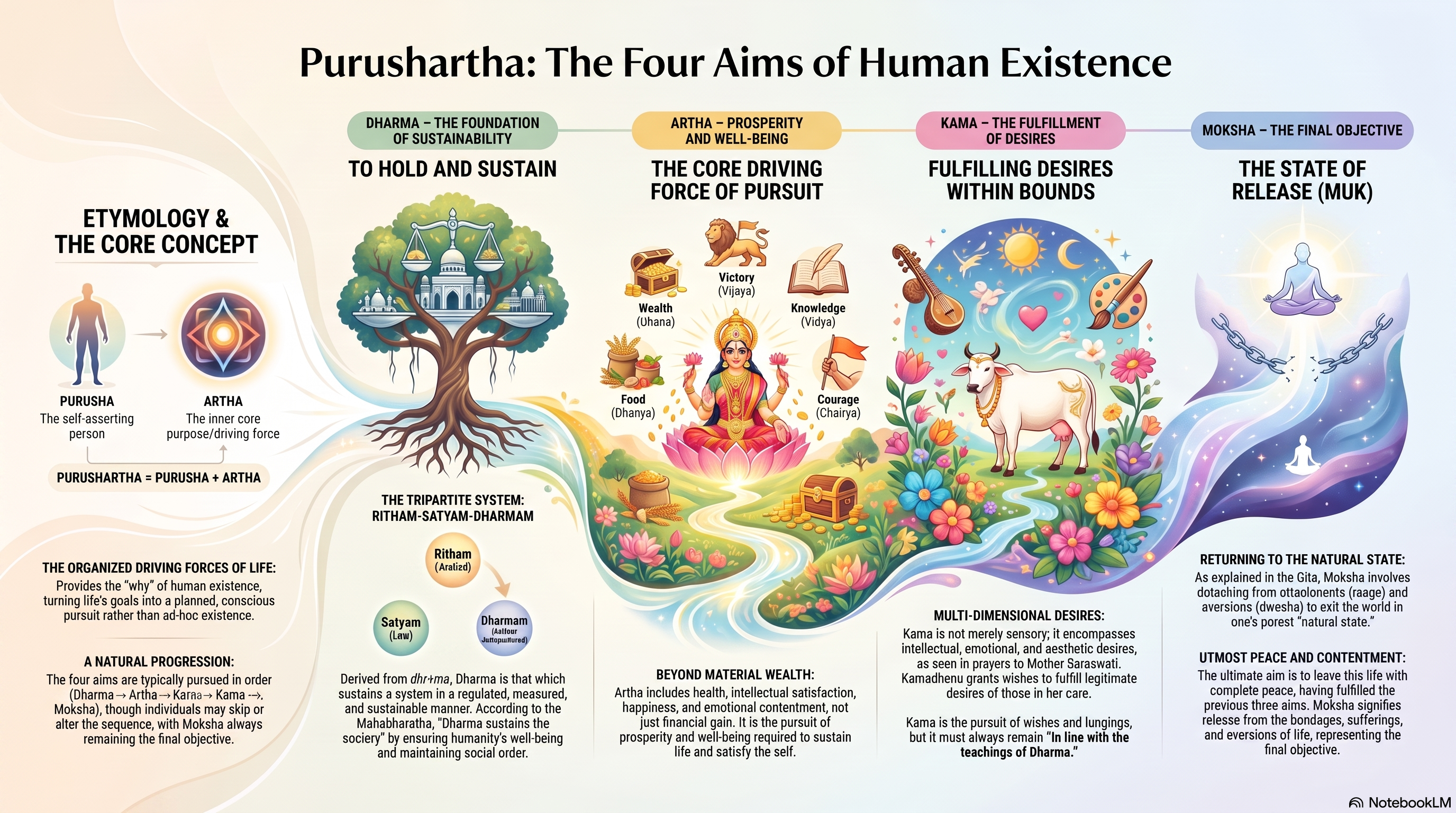
The word 'purushartha' is a compound derived from 'purusha' and 'artha' — root words that together shape its entire meaning.
Hence 'purushartha', in its simplest definition, stands for the pursuits of a human for this life.
The Concept
The purushartha are the pursuits of life — in simple terms, the meaning or purpose of life. They address the fundamental question of why we are born and what we are trying to accomplish in this life. There are four main pursuits: dharma, artha, kama, and moksha. These are often practiced in this natural order, but one can always skip one or more intermediate steps, with moksha as the final objective.
Every human, knowingly or unknowingly, naturally works toward one or more of these four aims through the length of their existence.
Like everything else in life, it makes more sense to understand the concept and work toward it in an organized, planned manner than to pursue it ad-hoc.
Dharma
The word is derived from 'dhr + ma', which translates to 'hold or sustain in a controlled or measured way'. In essence, dharma is that which sustains a system in a well-regulated manner. The pursuit of dharma is about learning and understanding the truths of society, nature, and life — and further, seeing how these can be improved in a sustainable way.
The concept of dharma is best understood as part of a tripartite system — ritham-satyam-dharmam:
This is roughly analogous to the relationship between Justice, Law, and Jurisprudence — where justice is the realization of truth (what is 'just'), law expressly codifies what is understood about justice, and jurisprudence is the system of procedures that uses law to make justice happen.
In the Mahabharata (Shanti Parva 12.110.11), Bhishma explains dharma thus:
dhāraṇād dharma ityāhuḥ dharmo dhārayate prajāḥ |
ya syād dhāraṇa samyuktaḥ sa dharma iti niścayaḥ ||
Dharma sustains the society and maintains the social order — dharma ensures the well-being of humanity, and surely is that which fulfills these objectives.
Artha
As described earlier, the word artha comes from the dhaatu 'rta', the core driving force of the subject in question. In the context of purushartha, it was about the purpose and meaning of life. As a pursuit of life, it is about prosperity and well-being as the core driving force.
Prosperity is often misunderstood to be just about material wealth, but it is far more than that. An easier way to understand artha as 'prosperity and well-being' is through the different aspects of Goddess Lakshmi, the deity of that exact purpose.
Dhana (wealth), dhanya (food), vijaya (victory), santana (offspring), dhairya (courage), vidya (knowledge), saubhagya (fortune), vara (blessings), rajya (majesty) — all of these are part of artha constituting prosperity, alongside health, intellectual satisfaction, happiness, and emotional contentment.
Basically, anything that drives a human to acquire things for their own satisfaction is part of artha — and all of it forms this pursuit.
Kama
The word 'kama' comes from the dhatu 'kam', meaning desire, wish, or something one longs for. This is perhaps the most misunderstood and maligned term, given its popularity with negative connotations as part of the ari-shad-varga — the six enemies within. The incorrect reading of the Kama Sutra as merely a 'sex manual' only makes it worse.
Every human has desires and wishes they want to fulfill. The pursuit of kama is about fulfilling those desires while staying in line with the teachings of dharma. A balanced, constructive way to understand this is through Kamadhenu — the divine cow who grants any wish to fulfill the desires of those in her possession.
Wishes and desires are not just sensory in nature, but also intellectual, emotional, and aesthetic — one's pursuit of kama is about fulfilling those desires while staying within the bounds of dharma.
In Bharatiya samskruthi, it is common for the following mantra to be chanted to Devi Saraswati before beginning education-related activities:
sarasvatī namastubhyaṃ varade kāmarūpiṇī |
vidyārambhaṃ kariṣyāmi siddhirbhavatu me sadā ||
Salutations Mother Saraswati, giver of boons, fulfiller of desires — bless me, so that I begin my studies successfully, may there be accomplishments.
Moksha
The word 'moksha' comes from the dhatu 'muk', meaning to release. Among the four pursuits, moksha is considered the final objective of life — to be released at peace from the bondages and sufferings of this life, and to exit with the utmost peace and contentment.
The pursuit of moksha, as explained in the Gita, is to be detached from raaga-dwesha (attachments and aversions), and to be able to leave this world in the most natural state — the way we came in at birth, by shedding all that was imposed on us afterward.
Summary
The four pursuits — also the purpose, aim, or goals of life — are dharma, artha, kama, and moksha. While these are generally practiced in this natural order, one can alter the order of the first three and even skip some of them. The fourth pursuit, moksha, is universally accepted as the last one, and stands as the core objective of life.
— Mohan Krishna Sonti (2022)