Mahabharata and Ramayana: Practical Application
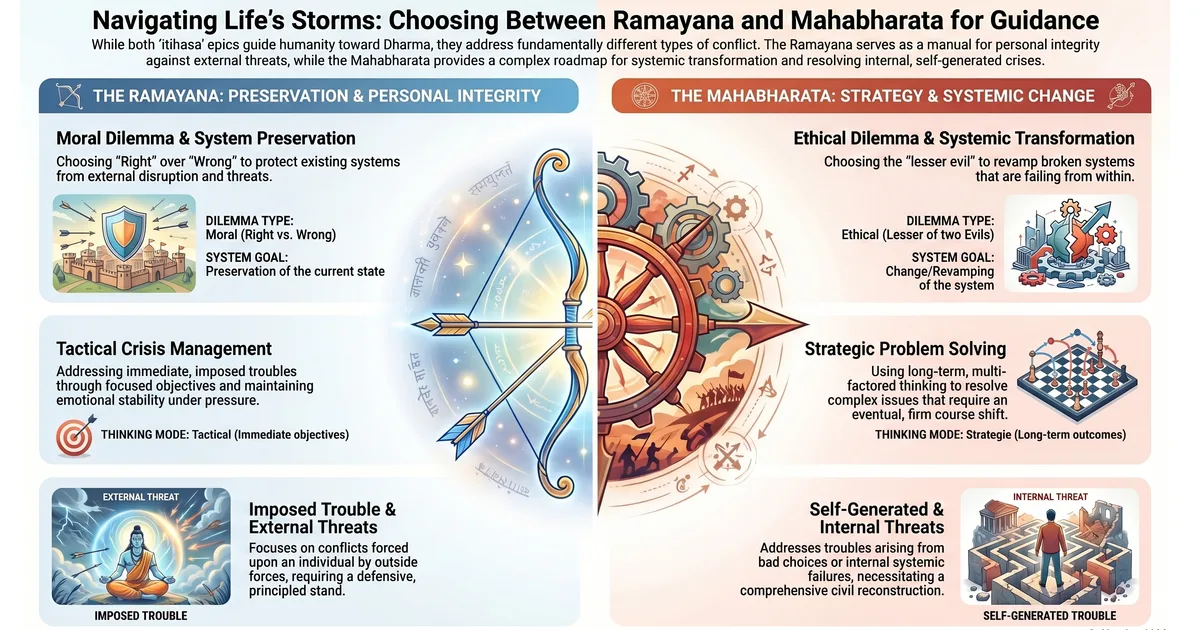
The 'Itihasa' containing Ramayana and Mahabharata are the longest epics written by mankind. There are several lessons and many ways to understand these epics. It can be sliced and diced into innumerable philosophical nuggets. Here is one such practical way that all humans can understand and apply it to everyday life. This is a perspective and advice about the epic one should refer to when in need of guidance in life.
1) Moral Dilemma versus Ethical Dilemma
There are no clearly defined and strict definitions of the words 'Morals' and 'Ethics' that are widely accepted across the world. Using these English words in the context of other world cultures only makes it even more difficult to define and understand. For the purpose here, please accept the following definitions so we can move to the idea that is being presented.
Ramayana
Guides people when faced with a Moral Dilemma — the choice between 'right and wrong'. Shri Rama was an unchallenged prince to the throne, born with all the comforts of life. Yet his entire life was filled with hardships on the sole account of following what is Dharmic. He chose to stand his ground and do the 'right' while fighting the 'wrong' relentlessly and with patience.
Mahabharata
Guides people when faced with an Ethical Dilemma — the choice between 'wrong and wrong'. This was expressed by Arjuna to Shri Krishna right before the Kurukshetra war, where the Bhagavad Gita was revealed. Should Arjuna be responsible for the death of millions — to establish Dharma — or let them suffer through Adharmic rule, leaving the problem for subsequent generations?
Ramayana is a guide for Moral Dilemmas — choosing between right and wrong. Mahabharata is a guide for Ethical Dilemmas — choosing between wrong and wrong.
2) System Preserver versus System Change Maker
Ramayana
Guides people whose conflict is about preserving their existing system and principles from threats — System Preservation. The kingdoms around Ayodhya were doing fine with no one disturbing their dharmic way of life. Then came Ravana who disrupted the existing system. Shri Rama's fight was a Dharmic one against Adharma to preserve what existed.
Mahabharata
Guides people whose conflict arises from a deep systemic failure requiring revamping — System Change Making. The lines between Dharmic Pandavas and Adharmic Kauravas were blurred; both sides did questionable acts. It was a comprehensive systemic failure at every level. Shri Krishna carefully managed the warring sides to revamp the existing system and usher in a new Yuga.
3) External Threat versus Internal Threat
Ramayana
Guides people if the threat to family/society/community is external to the system — the fight is against an External Threat. Ravana was an external threat to all, from individuals to Nations, who were otherwise leading a relatively peaceful and Dharmic life. The correction was made by Shri Rama.
Mahabharata
Guides people if the threat to family/society/community is internal to the system — the fight is against an Internal Threat. From Duryodhana to Bhishma and even Karna, many challenged the system from within — bordering a civil war!
4) Imposed Trouble versus Self Generated Trouble
Ramayana
Guides people if the trouble is imposed upon them from external sources — resolving an Imposed Trouble. Shri Rama and Mother Sita's peaceful life was blatantly meddled with by Ravana — they otherwise had nothing to do with him.
Mahabharata
Guides people if the trouble is self generated due to bad choices and circumstances — resolving Self Generated Trouble. Yudhistara, Bhishma, Duryodhana — all made wrong choices and put themselves in bad circumstances.
5) Tactical Thinking versus Strategic Thinking
Ramayana
Guides people to resolve issues that need Tactical Thinking. Shri Rama needed to get Mother Sita back safe and sound, and never let such a thing repeat again for anyone — the battle was simply to eliminate Ravana.
Mahabharata
Guides people to resolve issues that need Strategic Thinking. The build-up to the Kurukshetra war was long and progressive, leading to an eventual victory of Dharma over Adharma and getting society broadly back on course.
6) Crisis Management versus Problem Solving
Ramayana
Guides people in need of Crisis Management. Shri Rama's life was a sad one being perennially in crisis — and he resolved it on a Dharmic path with a resolute and stable mind — with no vengeance, frustration, anger or losing emotional control.
Mahabharata
Guides people in need of Problem Solving. Shri Krishna had a beautiful and happy life on the whole, but was cognizant of the existing Adharmic situation of the administration and society that required a resolute and persistent effort to solve.
Understanding these 6 points can certainly help us know where to look for when we need some guidance in life.
For Dharma … NOW and FOREVER!!