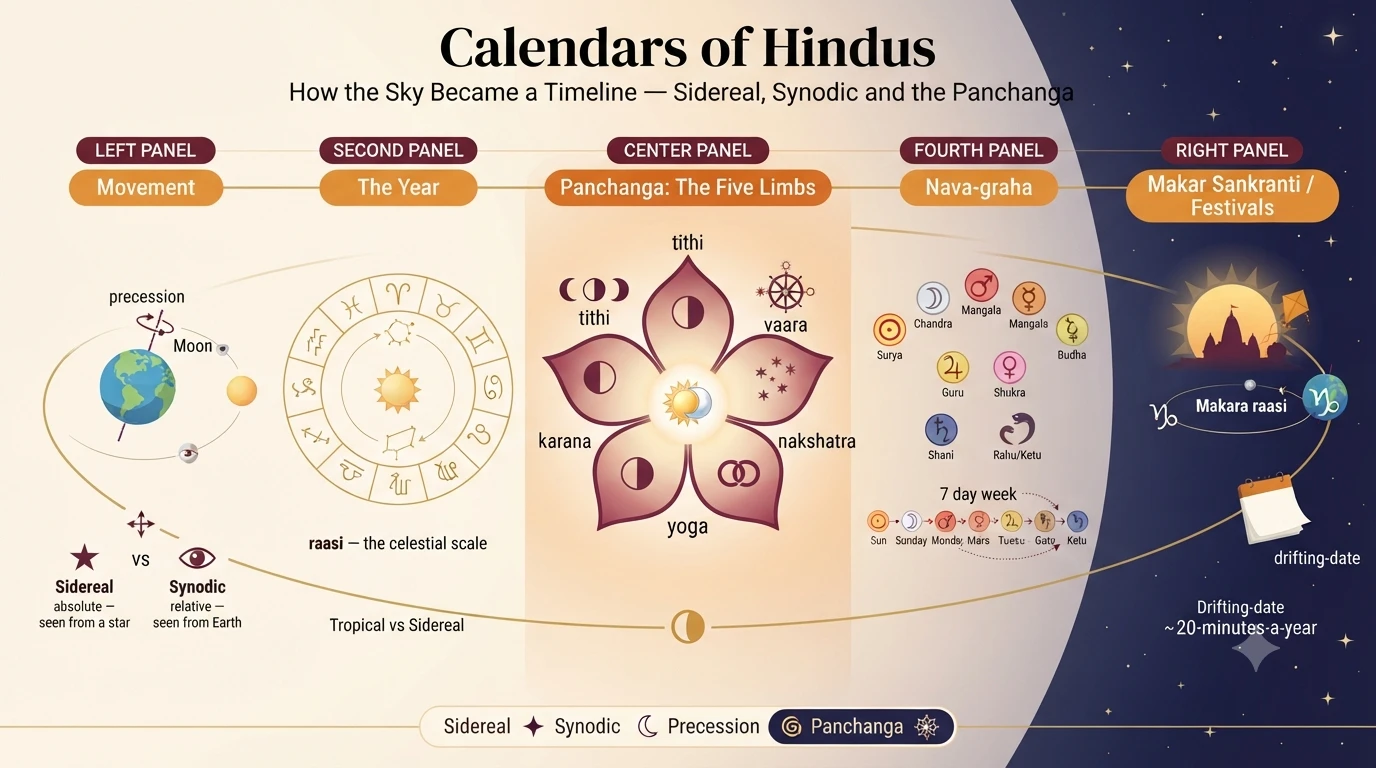
Calendars of Hindus
A calendar, in general, is about time keeping — accounting for and organizing the timeline. In a broader sense, it perhaps started as a need for food gathering and cultivation for any culture, because in a given span of time, the seasons and weather change in a periodic manner — synchronizing with nature and its events. This periodic change is based on the fact that Earth revolves around the Sun. We call one full revolution around the Sun a 'year'.
Movement
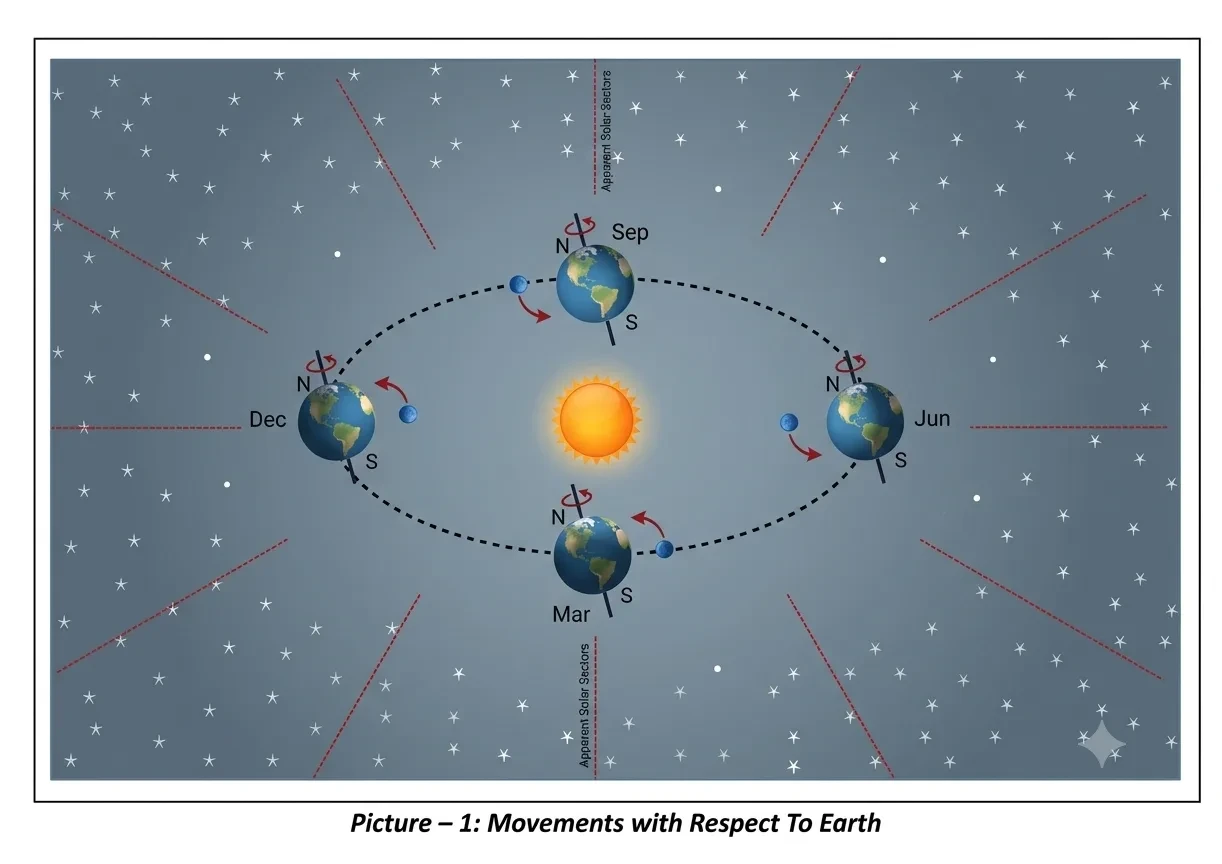
Keeping time requires us to first understand everything that moves — real and apparent — with respect to where we live, called Earth. The following things move:
| Motion | Duration | Nature |
|---|---|---|
| Earth spins around its own axis | A little less than 24 hours (1 day) | Real |
| Earth revolves around the Sun | A little over 365 days | Real |
| Moon revolves around the Earth | A little over 27 Earth days | Real |
| Moon spins around its own axis | Almost the same time as revolving around Earth | Real, but appears as not spinning |
| Stars 'move' at night | — | Apparent, due to Earth's revolution around the Sun |
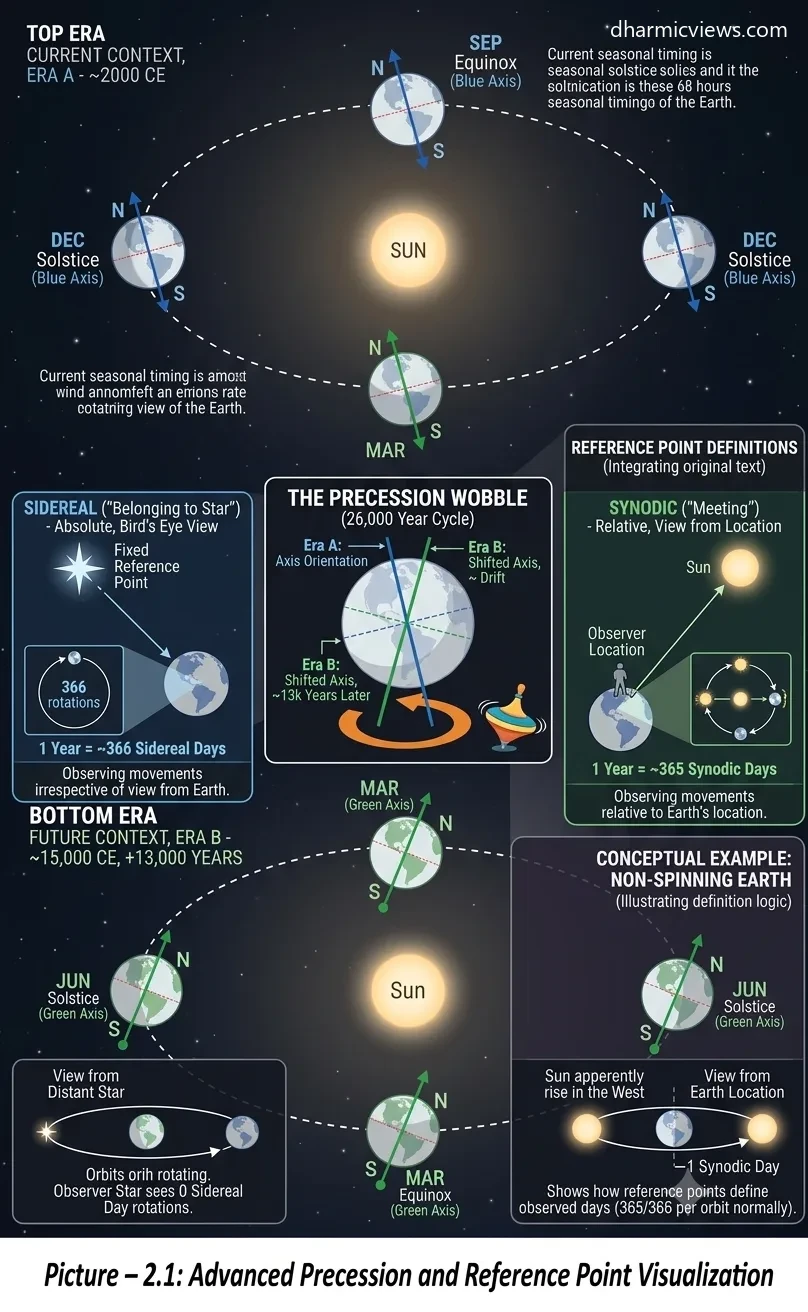
In addition to this, Earth has another motion called . Imagine a toy spinning top — it spins around its axis, but the axis itself also 'wobbles' around in circles when observed from the top. That circular wobbling of the spinning axis is precession. Likewise, the axis of Earth, which is slightly inclined with respect to the Earth-Sun plane, also wobbles — that wobble is the precession motion of Earth. The axial precession takes about 26,000 Earth years to complete one full cycle, changing the seasons' position relative to the distant stars over that span.
Reference Points: Sidereal versus Synodic
Setting aside the accuracy of the values themselves, the durations of the movements mentioned above also differ based on the reference point we choose. There are two such reference points immediately apparent to us.
| Reference Point | Root | Vantage | Nature |
|---|---|---|---|
| Latin 'sidereus' — 'belonging to a star' | Observed from a distant star | Absolute, irrespective of what we see from Earth (a bird's-eye view) | |
| Latin 'synodus' — 'meeting' (as in 'synchronizing') | Observed from Earth | Relative to our location |
For example, if Earth wasn't spinning at all but was still revolving around the Sun, then after one full revolution we would have zero Sidereal day but '-1' (a lost day) Synodic day. That's because, as observed from a distant star, Earth did not spin at all — zero Sidereal day. But a person living on Earth would observe the Sun apparently rise from the west and set in the east once that year — one full day, but in the opposite direction, i.e. one Synodic day (rather, '-1').
When we say there are about 365 days in a year, those are Synodic days. The Sidereal days are about 366 — because, as seen from a distant star, Earth actually spun 366 times that year.
The Year
We know Earth spins about its axis and revolves around the Sun, and that the spin axis is tilted with respect to the Earth-Sun plane — giving us changing seasons through the year. One complete revolution around the Sun with periodic, repetitive seasons makes one year. We call this Synodic year 'Tropical' — from the Greek root 'tropicos', meaning 'turn, change, or solstice'.
Because Earth's axis wobbles (precession), the absolute location of a particular season changes with time. Since the precession cycle is about 26,000 years, in about half that time (13,000 years) Earth's location for the same season sits on the opposite side of the Sun. Given the known retrograde direction of the wobble, looking from a distant star, the Tropical Year makes for slightly less than a 360-degree revolution around the Sun. The full 360-degree revolution is called the Sidereal Year.
The angular difference between the Tropical Year (shorter) and the Sidereal Year (longer) is about 360/26000 degrees — roughly 50 arc seconds, or about 20 minutes per year. After one full Tropical year, we on Earth experience the exact same season — but it takes 20 more minutes for Earth to reach the same exact absolute position in space relative to the Sun, as seen from a distant star.
The Calendars
So now the question is: how do we measure the Year? That is a calendar.
| Calendar Type | Basis | Accounts for Precession? | Where Used / Notes |
|---|---|---|---|
| ~365 Earth rotations per Solar year, divided into variable-size months with fixed-size weeks | Yes (saayana) | Sections of Tamil Nadu, Kerala, etc. Technically closest to the western Gregorian Calendar | |
| One complete absolute revolution of Earth around the Sun | No (nirayana) | Exists in parts of India; little practical value for seasons/agriculture | |
| Fixed-size months from the Moon's Synodic revolution (~29.5 days = 30 tithi), weeks from Earth's spin, extra adhika maasam every ~32 months | Yes (saayana) | The most widely used calendar across the country | |
| Pure Lunar | Exclusively the Moon's revolution (~30 days), no adjustment for Earth's solar year | No | Ancient preliminary step to the Luni-Solar calendar; no notion of seasons; still used in Islamic societies |
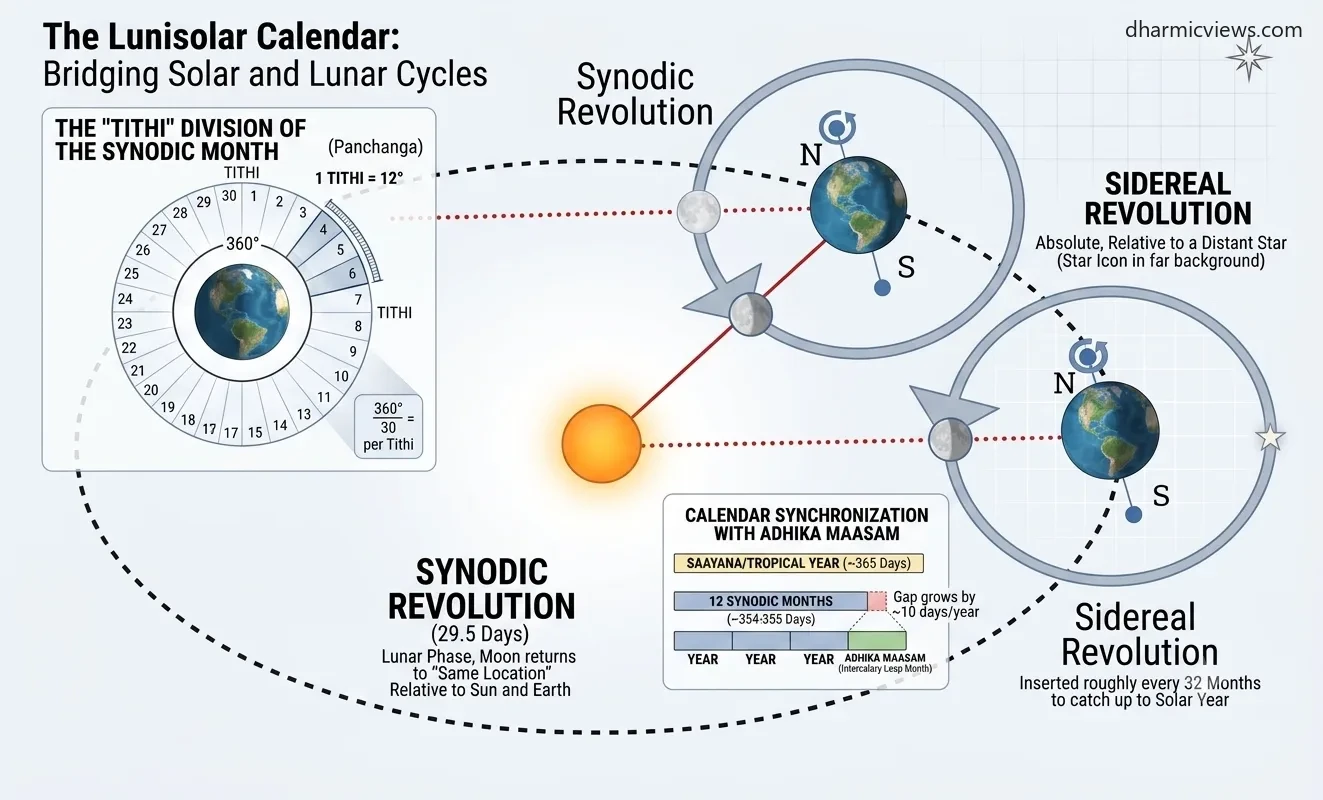 Picture – 3: Moon's Synodic and Sidereal Revolution Around Earth
The Synodic/Tropical Solar Calendar's days have no immediate practical value in their Sidereal form — so any mention of Earth's rotations should be assumed Synodic unless stated otherwise. While the Gregorian Calendar (itself a correction of the Julian Calendar) is the most widely used in the world today, it is built on the same principles as this ancient Solar Calendar of India.
In the Luni-Solar calendar, the Moon completes an apparent 360 degrees around Earth in each Synodic revolution, so the ~29.5 days are divided into 30 equal units called tithi — each a 12-degree angular change of the Moon in the sky. (The Moon's Sidereal revolution, by contrast, takes only a little over 27 days — the absolute, one-complete-revolution figure as observed from a distant star; the Synodic revolution is longer because Earth itself is moving around the Sun during those days.) Dividing the Tropical Year into equal-size months this way leaves about 10 days unaccounted for each year, so roughly every 32 months an extra month called adhika maasam is added to realign the calendar.
A more complex variant combining the nirayana and saayana systems — the Panchanga — is very ancient and very widely used across India.
Panchanga: The Five Limbs
literally translates to 'five limbs' (pancha + anga). It is a Sidereal-Synodic based, complex calendar. The five limbs are tithi, vaara, nakshatra, yoga and karana — though several other concepts are intrinsically involved, such as graha, maasa and raasi. Below is a description of each, traced from its dhaatu (root concept, marked with √).
tithi
√ tij — to be precise, sharp, accurate. The concept of 'getting it exact'.
From this root came atithi (a guest — one with no precise, fixed time of arrival) and tithi itself, meaning 'a precise division' — roughly, the 'exact division of lunation'.
The Moon's Synodic revolution around Earth takes about 29.5 days and is, by definition, 360 degrees as observed from Earth. Tithi divides those 29.5 days into precisely 30 equal units, making it the quasi-equivalent of a 'day' for time-keeping purposes. Since one Synodic Earth day (divasa) is also divided into 24 hours (hora), this superimposition gives two vectors of time keeping: the 24-hour Earth day, and the 30-tithi lunar month (maasa).
The 30 tithi are named identically across the waxing (sukla/suddha paksha) and waning (krishna/bahula paksha) halves of the month:
| # (Sukla Paksha) | Tithi Name | # (Krishna Paksha) | Tithi Name |
|---|---|---|---|
| 1 | pratipada / padyami | 16 | pratipada / padyami |
| 2 | dwitiya / vidiya | 17 | dwitiya / vidiya |
| 3 | tritiya / tadiya | 18 | tritiya / tadiya |
| 4 | chaturthi / chaviti | 19 | chaturthi / chaviti |
| 5 | panchami | 20 | panchami |
| 6 | shashti | 21 | shashti |
| 7 | saptami | 22 | saptami |
| 8 | ashtami | 23 | ashtami |
| 9 | navami | 24 | navami |
| 10 | dashami | 25 | dashami |
| 11 | ekadasi | 26 | ekadasi |
| 12 | dwadasi | 27 | dwadasi |
| 13 | trayodasi | 28 | trayodasi |
| 14 | chaturdasi | 29 | chaturdasi |
| 15 | pournami / poornima | 30 | amavasya |
raasi
√ rāś — a sum or collection of something. (From the same root, combined with √trai, 'to protect', comes rāṣṭrá — a country, a protected collection of land.)
Raasi means 'a collection or set' — roughly, the 'zodiac'.
Since the Moon completes 12 Synodic revolutions around Earth in a year (with about 10 extra days left over), the relatively stagnant background sky provides a steady reference for that repetition. This divides the 360-degree sky into 12 units called raasi, each identified with a distinct cluster of stars — a fixed celestial scale through which Earth navigates.
The 12 raasi are:
| Raasi (Samskrutam) | English |
|---|---|
| meṣaḥ | Aries |
| vṛṣabhaḥ | Taurus |
| mithunaḥ | Gemini |
| karkaḥ | Cancer |
| siṁhaḥ | Leo |
| kanyā | Virgo |
| tulā | Libra |
| vṛścikaḥ | Scorpio |
| dhanuḥ | Sagittarius |
| makaraḥ | Capricorn |
| kumbhaḥ | Aquarius |
| mīnaḥ | Pisces |
maasa
√ maa — to measure, the idea of quantifying. √ sa — to bind, the idea of putting together in balance.
Together they give maasa — 'uniformly measured', roughly translated as 'month'. (The same root √maa, via Greek, gives the English word 'meter'.)
One complete Lunar Synodic revolution around Earth is a maasa, and there are 12 named maasa in a year. Since the raasi forms an absolute celestial scale of 12 equal parts while the 12-maasa year drifts by about 10 days annually, that drift accumulates to one full maasa roughly every 32 months — at which point an extra month, prefixed 'adhika' ('extra'), is inserted to realign the maasa with the raasi.
The 12 maasa, with their reference raasi:
| Maasa | Raasi | Maasa | Raasi |
|---|---|---|---|
| chaitra | mīnaḥ | ashvini | kanyā |
| vaishakha | meṣaḥ | kaartika | tulā |
| jyeshtha | vṛṣabhaḥ | margasheersha | vṛścikaḥ |
| aashada | mithunaḥ | poushya | dhanuḥ |
| shraavana | karkaḥ | maagha | makaraḥ |
| baadhrapada | siṁhaḥ | phalguna | kumbhaḥ |
graha
√ grah — to tie, grasp, fasten, hold captive. (From it: aagrah, eager/persistent; nigrah, to restrain.)
Graha means 'one that holds, has an influence or pull' — roughly, 'planet'. But with respect to Earth, a graha is not a 'planet' in the modern sense; it is any celestial object with considerable influence on Earth. In that sense there are 7 graha, plus two calculated reference points — Rahu and Ketu — derived from the intersection line of Earth's and Moon's equatorial planes (the northern and southern points respectively). When the Moon sits at those points while aligned with the Sun, that causes lunar and solar eclipses. Together, these nine are the nava-graha.
| Graha (Samskrutam) | English |
|---|---|
| surya, aditya | Sun |
| chandra, soma | Moon |
| mangala | Mars |
| budha | Mercury |
| bruhaspathi, guru | Jupiter |
| shukra | Venus |
| shani | Saturn |
| rahu | North intersecting point |
| ketu | South intersecting point |
Shri Veda Vyasa's stotram on the nava-graha summarizes them in a verse:
ādityāya ca somāya maṅgaldāya budhāya ca |
guru śukra śanibhyaśca rāhave ketave namaḥ ||
And from the Brihad Paraashara Hora Shastra (Chapter 3, Verse 10):
atha khetaa ravischandro mangalascha budhastatha |
guruh shukrah shanee raahuh ketuschaite yathakramam ||
vaara
Vaara (or vaasarah) generally means 'week' — from the dhaatu √vṛ, 'to cover, encompass, surround'. Based on Vedic roots found the world over, a week is universally accepted to have 7 days, based on the 7 identified graha in the same order as above.
Each culture named its day after the same body in its own tongue. The color-coded tags below trace that word's journey — R Roman, L Latin, G Germanic, N Norse, O Old English — so the same tag color always marks the same layer of history as you scan down the table.
| Graha (Samskrutam) | Vaara (Samskrutam) | Body | Word Trail | Current Name |
|---|---|---|---|---|
| ravi, surya, aditya | adi/ravi-vaasarah | ☉ Sun | L Solis · G Sunno | Sunday |
| chandra, soma | soma-vaasarah | ☾ Moon | L Lunae · O Monan | Monday |
| mangala | mangala-vaasarah | ♂ Mars | R Mars · L Martis · G Tiu | Tuesday |
| budha | budha-vaasarah | ☿ Mercury | R Mercury · L Mercurii · G Woden | Wednesday |
| bruhaspathi, guru | guru-vaasarah | ♃ Jupiter | R Jupiter · L Jovis · N Thor | Thursday |
| shukra | shukra-vaasarah | ♀ Venus | R Venus · L Veneris · N Frigg | Friday |
| shani | shani-vaasarah | ♄ Saturn | R Saturn · L Saturni | Saturday |
Seven graha, seven names, one sky — every ancient culture simply looked up and read the same week.
nakshatra
√ kshi — to possess, have power over. (From it: kshetra, region/land/property.)
Nakshatra ('na' + 'kshatra') means 'one that possesses no pull or power' — roughly, 'stars', which, unlike graha, hold no significant gravitational influence on Earth.
The Moon's Sidereal revolution around Earth takes a little over 27 Synodic Earth days. Tithi accounts for the Moon's Synodic revolution (30 units of the apparent 360 degrees); nakshatra does the analogous job for the Moon's Sidereal revolution — mapped onto the stationary sky, the true celestial scale. This span was initially divided into 28 equal units, but was later changed to 27 equal units (360/27 = 13° 20′, or 800 arc minutes) for cleaner division. Each nakshatra is further divided into 4 pada (steps) of 3°20′ (200 arc minutes) each.
The 27 nakshatra (per Brihad Paraashara Hora Shastra, Chapter 3):
| # | Nakshatra | # | Nakshatra | # | Nakshatra |
|---|---|---|---|---|---|
| 1 | ashwini | 10 | maghā | 19 | mula |
| 2 | bharani | 11 | pūrva phalgunī | 20 | purva ashada |
| 3 | krittika | 12 | uttara phalgunī | 21 | uttara ashada |
| 4 | rohini | 13 | hasta | 22 | sravana |
| 5 | mrigashīrsha | 14 | chitra | 23 | dhanishta |
| 6 | ardra | 15 | swāti | 24 | shatabhisha |
| 7 | punarvasu | 16 | vishakha | 25 | purva bhādrapadā |
| 8 | pushya | 17 | anuradha | 26 | uttara bhādrapadā |
| 9 | āshleshā | 18 | jyeshtha | 27 | revati |
yoga
√ yuj — to join, to synchronize elements into harmony. (From it: yojaka, an organizer; yojana, the act performed.)
Yoga means 'act of joining or putting together', with no direct English equivalent in this context.
There are two Sidereal revolutions at play in this system: the Moon around Earth, and Earth around the Sun. There are 27 yoga, just as there are 27 nakshatra — the first yoga is aligned with the first nakshatra as a reference point. Earth's 360-degree Sidereal revolution around the Sun is likewise divided into 27 equal units (13°20′ each). The duration of a nakshatra tracks only the Moon's angular revolution; the duration of a yoga tracks the sum of the Moon's angular revolution around Earth and Earth's angular revolution around the Sun reaching 13°20′ — making a yoga about 1/27th shorter than a nakshatra. The concept is similar to a Vernier caliper.
The 27 yoga are:
| # | Yoga | # | Yoga | # | Yoga |
|---|---|---|---|---|---|
| 1 | viṣkambha | 10 | gaṇḍa | 19 | parigha |
| 2 | prīti | 11 | vṛddhi | 20 | śiva |
| 3 | āyuśmān | 12 | dhruva | 21 | siddha |
| 4 | saubhāgya | 13 | vyāghatā | 22 | sādhya |
| 5 | śobhana | 14 | harṣaṇa | 23 | śubha |
| 6 | atigaṇḍa | 15 | vajra | 24 | śukla |
| 7 | sukarma | 16 | siddhi | 25 | brahma |
| 8 | dhrti | 17 | vyatipāta | 26 | māhendra |
| 9 | śūla | 18 | variyas | 27 | vaidhṛti |
karana
√ kṛ — to do, make, perform, accomplish, effect, construct. (From it: kaarya, that which is to be done.)
Karana means 'doing, making, effecting, causing', with no direct English equivalent here.
A karana groups tithi the way vaasarah groups Synodic days — one karana is exactly half a tithi, giving 60 karana across a 30-tithi lunar month. There are 11 types of karana in total, but only 7 recur repeatedly: 4 karana appear just once each (2 for the two halves of amavasya, and one each immediately before and after it), leaving 7 types that cycle 8 times across the remaining 56 karana — much like the 7-day week cycling through the month.
The 2 karana on each half-tithi across the full month (sukla and krishna paksha) map out as follows:
| Tithi (Sukla Paksha) | Karana (1st half / 2nd half) | Tithi (Krishna Paksha) | Karana (1st half / 2nd half) |
|---|---|---|---|
| pratipada/padyami [1] | kiṃstughna / bava | pratipada/padyami [16] | bālava / kaulava |
| dwitiya/vidiya [2] | bālava / kaulava | dwitiya/vidiya [17] | taitula / garija |
| tritiya/tadiya [3] | taitula / garija | tritiya/tadiya [18] | vaṇija / viṣṭi |
| chaturthi/chaviti [4] | vaṇija / viṣṭi | chaturthi/chaviti [19] | bava / bālava |
| panchami [5] | bava / bālava | panchami [20] | kaulava / taitula |
| shashti [6] | kaulava / taitula | shashti [21] | garija / vaṇija |
| saptami [7] | garija / vaṇija | saptami [22] | viṣṭi / bava |
| ashtami [8] | viṣṭi / bava | ashtami [23] | bālava / kaulava |
| navami [9] | bālava / kaulava | navami [24] | taitula / garija |
| dashami [10] | taitula / garija | dashami [25] | vaṇija / viṣṭi |
| ekadasi [11] | vaṇija / bava | ekadasi [26] | bālava / kaulava |
| dwadasi [12] | viṣṭi / bālava | dwadasi [27] | taitula / garija |
| trayodasi [13] | kaulava / taitula | trayodasi [28] | vaṇija / viṣṭi |
| chaturdasi [14] | garija / vaṇija | chaturdasi [29] | śakuna / catuṣpāda |
| pournami/poornima [15] | viṣṭi / bava | amavasya [30] | nāga / kiṃstughna |
Notes and Practical Application
Festivals — Most Hindu festivals, such as Vijayadashami, Ugadi, Diwali and Holi, follow either the full Panchanga or the simpler Synodic Luni-Solar calendar, celebrated on specific tithi of the lunar months. In every sense, they fall on the "same day" if the Hindu calendar is followed — the date naturally varies only when mapped onto a purely Solar calendar such as the Gregorian.
— The word comes from 'sankramana', meaning to 'cross over or transit', referring to Earth's crossing from one raasi to another — there are 12 sankranthi in a year. Makar Sankranti, the most celebrated, marks Earth's transit into makar raasi. This is a Sidereal event: irrespective of Earth's precession (a Synodic phenomenon that drifts seasons across the celestial scale), the celebration stays pegged to the fixed celestial scale (raasi). So on any Tropical calendar such as the Gregorian, the date will always drift — by about 20 minutes a year, or roughly one day every 72 years.
Reference Year — All Solar calendars require a reference year to start counting from, since every year is otherwise identical and can only be distinguished by counting from that point. The scales used in the Panchanga run into thousands of years with a unique timestamp for any given moment, owing to the many data points — from fractions of a second to cycles of years — used to peg a specific date; tithi, vaara, nakshatra, yoga and karana above are only a few of those data points.
Summary
| Term | Quick Definition |
|---|---|
| Earth spins about its axis; the axis wobbles (precession); Earth revolves around the Sun; the Moon spins about its own axis (negligible); the Moon revolves around Earth; the stars appear to 'revolve' in the background | |
| A spin or revolution as experienced from a relative location, such as Earth | |
| A spin or revolution as seen from an absolute location, such as a distant star | |
| Earth's spin axis wobbles, completing the cycle in about 26,000 years. Saayana accounts for it; nirayana does not | |
| ~365 days per Earth revolution around the Sun, accounting for precession, divided into months and weeks from Earth's spin. Similar to the Gregorian Calendar | |
| One complete absolute revolution of Earth around the Sun, ignoring precession. Exists, but of little practical value | |
| ~365 days per year, accounting for precession, with fixed-size months from the Moon's Synodic revolution, weeks (vaasarah) from Earth's spin, and tithi dividing each lunar month into 30 units. The most commonly used calendar | |
| A Sidereal-Synodic calendar of five limbs: tithi (30 divisions of the Moon's Synodic revolution), vaara (7-day week from the graha), nakshatra (27 divisions of the Moon's Sidereal revolution), yoga (27 divisions combining both Sidereal revolutions), and karana (half-tithi units, 11 types) | |
| Earth's transit from one raasi to another (12 per year); a Sidereal event that drifts on Tropical calendars by about 20 minutes a year |
Sonti Mohan Krishna (2020)